Blog

  • The Mysterious Boston Boy Captain

    Identifying people in antique photos of ancestors–then finding their stories–can present fun history challenges.

    As my family’s armchair history detective, I became curious about the boy in this photo.

    Who was he? How could he have been a captain at such a young age? What happened to him?

    The photo was mixed up with miscellaneous photos from my attic. At first, I wasn’t sure which family line he even came from. So I decided to try combining family records with internet tools to get my answers.

    I checked for clues on the back of the photo, and found these notes written in ink:

    Capt. W.B. Piper, E.H.S Go Fi 1st Bat BSR ’89.

    As in 1889–one hundred and thirty seven years ago!

    My first challenge: WHO the heck was W.B. Piper?

    Thankfully I had a good start. The last name Piper is in a tree I previously created on Ancestry.com, so I recognized the Piper name. I have the app in my phone, so it’s very easy and quick to pull up a specific tree.

    In the Piper tree, a W.B. Piper did not appear anywhere. So as an experiment, I decided to temporarily add him to it. (If you try an experiment like this, I suggest you set your tree to Private; if Public others may copy your tree including potential errors.)

    But before adding him, I needed to guess which generation he was born into. I couldn’t make him his own grandfather, right?

    I pondered: why do I, in particular, own this photo? Which family member am I personally connected to in the Piper family tree, who would have logically passed this photo down to me?

    The answer lay in an antique lowboy given to me by my great-aunt Dorothy. In a drawer is a DAR certificate for an S. Lizzie Piper. (Her fun story I’ll share about in another post.)

    Anyhow, I knew by now that Dorothy’s mom, Gretchen, had an aunt Lizzie. It seemed logical that W.B. would be connected to Gretchen or Lizzie, for Dorothy to have had this photo and me to now have it.

    It made sense that I might have a picture of my aunt Dorothy’s uncle.

    So as you can see in the image of the tree below, based on Gretchen’s birth year and how old the boy in the photo looked in 1889, I added W.B. as Gretchen’s brother.

    Screenshot

    Bingo! Next to W.B.’s name, I clicked the waving green leaf and confirmed that his full name was William Benjamin Piper, so I did add him permanently to the tree.

    Official documents linked to clues in Ancestry.com revealed his parents names were indeed William Piper and Mary Green and Gretchen his sister.

    Woohoo! Official grave information found via the app recorded his exact birth date, which fit perfectly. He was only a year younger than his sister Gretchen.

    (As a side note, as you look at the tree above, you’ll see a Susan Elizabeth Greene or Green, who was S. Lizzie Piper. I think she must have been a fun person to insist on being called Lizzie instead of Susan or Elizabeth!)

    My second challenge: Decipher the notes on the back of the photo.

    I typed into a Google Search in my computer the strange abbreviations to see what they might mean:

    Again, those were: Capt. W.B. Piper, E.H.S Go Fi 1st Bat BSR ’89.

    Google Search made a few guesses, but as I later discovered got many of the abbreviations wrong. It was on the right track though–thinking E.H.S. was a high school. That made sense, as I now knew the photo was taken in 1889 when William was only sixteen years old.

    But Google’s AI could only guess at the military notes, so it was time for:

    My third challenge: Upload the photo to see if the military uniform could be identified.

    [Want to try this? Take a picture with your phone of an antique photo of ancestors, or one ancestor, who you can’t quite place. It helps to also have the Google app in your phone. Go to your Photos folder, and select that photo. Click the tiny upload/share box with an upward arrow below your photo. Next, click Google, then Search with Google Lens.]

    Because I included the whole photo (including watermarks for a Boston photography studio) then selected advanced AI, I quickly solved the school and captain mysteries.

    “E.H.S.” was the English High School in Boston. “Go Fi” was the sports team’s cheer for “Go Fight,” apparently when they played their rival, Boston Latin School.

    William wore a uniform for the Boston School Regiment of which he was captain of the first battalion. (1st Bat BSR )

    The Boston School Regiment was a military program for Boston high school students, also known as the Boston School Boy Cadets. It was started in 1863 during the Civil War, to prepare young men for potential service.

    It became a century-long tradition with competitive prize drills and parades. But by the 1950s it was phased out as JROTC began, going from involuntary to voluntary.

    Now that William had become a live person to me, I wondered what happened to him.

    Well, if you want to end this story on a happy note, read no further.

    But if you want the details: William Benjamin Piper’s life came to a tragic end. An ancestry link sent me to Newspapers.com, to which I also subscribe to, to read newspapers from the 1700s and 1800s. (That’s often great fun, by the way–though not reading the sad stories like this one.)

    William died in a hotel at only 23 years old (a few months shy of his 24th birthday.) The cause? Chloral poisoning. Chloral was used at the time as a sleep aid. William had overdosed, with the article suggesting it was due to “melancholy” (depression).

    That made me sad. Yes, he died 130 years ago, so of course would no longer be alive anyway. But still, what a tragedy for a family. It makes me think about how Dorothy’s mom was only 25 years old when she lost her brother, and my great-aunt Dorthy was born only 5 years later. I can recall having a preschooler while also grieving loss of a family member. Grieving is grieving, no matter what time period you live in.

    Below is a photo of the home where W.B.’s family lived (according to the address is listed in other documents attached to W.B. and a Google Maps search.) It’s certainly a beautiful home. I sincerely hope many beautiful memories have been made in that home in the five to six generations living it it since the loss of W.B.

    Are you inspired to research and identify people in antique family photos of your own, and find those ancestors’ hidden stories?

    I’d love to hear comments from you about any family mysteries you’ve solved this way.

    Laurie

    A little P.S. for Piper or Bartlett descendants:

    Dorothy Bartlett was married to my grandpa’s brother, Max Pearce. Her mother was Gretchen Pickering Piper (1871-1943.) Dorothy had no children, but had two brothers: Dudley Bradstreet Bartlett and Phillips Payson Bartlett. Their great-aunt was Susan Elizabeth Green (sometimes spelled Greene.)
  • Unfolding Grandma’s Secret: An Antique World Map Journey

    Unfolding Grandma’s Secret: An Antique World Map Journey

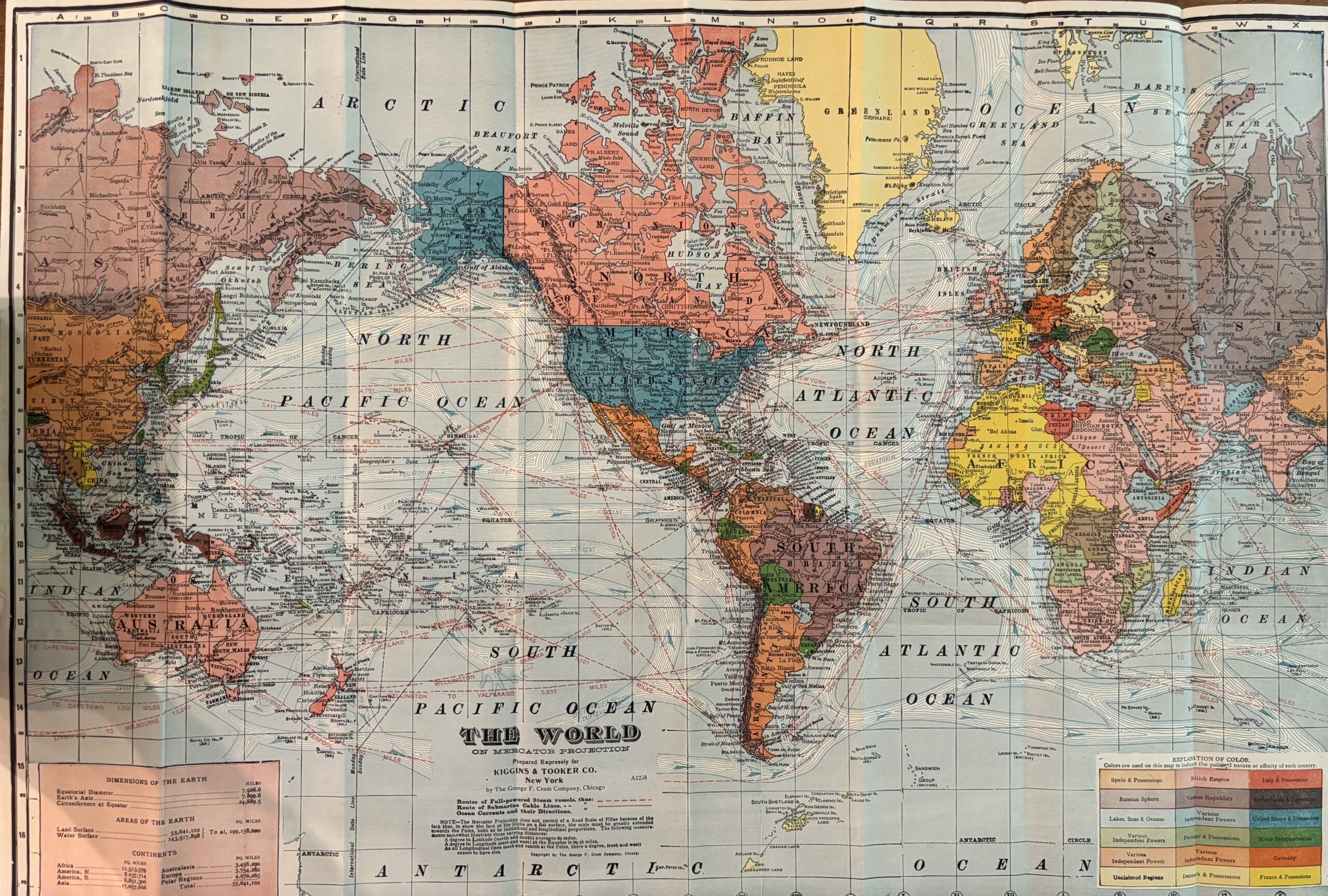
    Today’s exciting find: a historical 103-year-old world map, hidden in Grandma’s steamship travel journal!

    This 1922 antique world map (made by the George F. Cram company, Chicago; for Kiggins and Tooker CO, New York) reveals how far the British Empire and other ruling empires extended. (You can see the color-coding chart, bottom R on the map.)

    The map also includes dashes showing steamship travel paths through the seas.

    This helps me trace where Grandma’s ship sailed and stopped in 1926. The color-coding shows me who ruled the countries she passed through at that time (unless that changed shortly after the map was published.)

    As a bonus, note also the solid lines marked in the seas, indicating submarine cable lines from World War 1.

    (Later in this post you’ll see how the map unfolds from the journal.)

    Sometimes I think my own home is a historical wonderland!

    I have so many boxes of antique handwritten photos, letters, and other memorabilia, it’s easy to lose track of what I have. I joke that I came from a family of hoarders. But I DO relish items hoarded now for over a century which are now in my possession.

    It’s a historical writer’s dream, right?

    For the past year, I’ve searched for such a map online. In the meantime, I had this all along!

    I’m finally working more earnestly on my narrative nonfiction book about the years Gladys Gose Pearce and John Kenneth Pearce lived in India (1923-1933.)

    [My excuse for missing this map: I was temporarily derailed for a few years, assembling and editing a 1950s-1960s collection of vintage scifi short stories, written by yet another family member. See Gremmie’s Reef, now in print.]

    It helps that I’ve now switched my office research piles from vintage science fiction manuscripts back to the India artifacts. So I now have more at my fingertips, including this travel journal.

    Here’s how this antique world map physically unfolds:

    When Gladys wrote in this journal, she’d just begun her steamship journey. It would last 51 days.

    She noted that she boarded the S.S. President Garfield in San Francisco, California in August of 1926. She then had various stops in other countries and ship changes before finally landing in Madras, India to marry Grandpa Ken.

    A bit of their romantic history:

    Ken graduated from high school in Walla Walla, WA with Gladys in 1915. They then both attended the University of Washington in Seattle.

    After college graduation, Gladys went to San Diego to teach.

    In 1923, 25-year-old Ken (J. Kenneth Pearce) was sent to South India, to work as a Forest Engineer for the British Indian government.

    In the fall of 1925, Ken got a short home leave to visit Washington State. He then proposed to Gladys. It was about time! For ten whole years they’d been close friends. But during that visit, sparks flew.

    Gladys and Ken would live in India until 1933: first in South India, and later in the Andaman Islands.

    The Andaman Islands

    The Andamans are tiny specks on this world map, in the Bay of Bengal. The islands are east of the Indian mainland, near Burma (now Myanmar) and Siam (now Thailand.)

    This particular map has the Americas in the center (being published in the USA.) So the R edge of this map shows the mainland of India, while the L edge has the Andaman Islands.

    If you zoom in close you can see where Gladys put an arrow pointing to them. Seeing it on a globe or other-centered map might make it easier to visualize this.

    Still, what a great find this is! I now have this map as my computer screensaver.

    I’m sure the cartographers who drew it 103 years ago could have never imagined THAT.

    What’s in your own attic, basement, or closet? What surprise about your own ancestors awaits you…or have you already found?

    Please share your own discoveries in a comment, or email me via my Contact page. I’d love to hear from you.

    Laurie

  • Out now! Gremmie’s Reef: Classic Sci-Fi Short Stories from the 1950s and 1960s (Reawakened Worlds Vol 1)

    Out now! Gremmie’s Reef: Classic Sci-Fi Short Stories from the 1950s and 1960s (Reawakened Worlds Vol 1)

    7 Classic science fiction short stories by master storyteller, John Hayden Howard were compiled for Volume 1. In the 1960s he went by the pen name Hayden Howard, writing prolifically for science fiction magazines, and he’s listed in the Encyclopedia of Science Fiction.

    If the cover looks like another recent book, Reawakened Worlds Vol 1, YES: it’s the same book, new title! The series is still called Reawakened Worlds. Volume 2 will be released soon as well with a new title. Here’s the redesigned cover:

    A new title was necessary because when the publisher put up Vol 2 for pre-release, web pages on bookstore sites confused the two volumes. None of the links went where they were supposed to go. It was a colossal mess!

    The problem became insurmountable, so Reawakened Worlds Vol 1 was pulled, and both books re-titled, but with the same cool covers as before.

    Gremmie’s Reef released today, so if you didn’t already grab it with its former title, this is a good time! Special Amazon Kindle price of $2.99 for the launch! (Paperback, $15.49, Hardcover, $21.99)

    The new title was chosen from one of the stories in the book: Gremmie’s Reef. Here’s a blog post about that story.

    Also, if you want to read more detail about the whole book and the stories in it, visit my publisher’s blog post: https://wildbluepress.com/gremmies-reef-classic-sci-fi-john-hayden-howard

    Laurie

  • A Mysterious 1938 4th Grade Report Card

    A Mysterious 1938 4th Grade Report Card

    This post is in the series Stories from Family Memorabilia, on researching family history, via odd objects and papers.

    Today’s historical mystery is a 1938 4th Grade report card. It’s a strange report, from an odd location.

    And as usual, I can’t pick up any old family paper without it stimulating my curiosity. Like Paul Harvey, the old American radio broadcaster, I want “the rest of the story.”

    Despite the missing first name on this paper, I realize quickly I’m looking at my dad’s report card, since in 1938 he was 10 years old. Still, I noticed odd things about this report.

    Harsh Teachers

    For starters, one teacher’s comments were over-the-top insensitive. I’m not a fan of participation trophies, so mentioning he was sloppy or untidy was acceptable. But for his English teacher, H.D.H., to call him–any kid!–“lazy and unintelligent” raised my Mama hackles.

    Dad as an adult was both industrious and bright, working as a creative landscape architect. So I put on my psych cap. (I formerly worked in both psychiatric and educational Occupational Therapy.) What the heck was going on with Dad at age 10?

    Words from less harsh teachers described him in this report as “content with something much less than his best”, “aught to have done better”, “inclined to be erratic”, “rather mischievous”, disobedient, silly, slack, and forgetful. Ooooh, this is beginning to sound like a boy who had potential, but didn’t give a rip. But why?

    Conversely, his French teacher wrote “He is keen and intelligent and well ahead for his age.” His Scripture teacher wrote “listens well and answers intelligently.” And while Dad was 10, the average age of the class was 11 years old. Hmm. I’ve worked with gifted children who misbehaved out of sheer boredom.

    Children on the Move

    Finally I notice the words at the top: Form: “Remove” and in the tiniest cursive imaginable at the bottom of the report, “Knowing he is leaving has unsettled him, I think.”

    So Dad was leaving. To go where? And where, in the world (literally) was this school, teaching French and Latin to 4th graders?

    The odds were high he had just come from another country, and soon leaving for another. You see, Dad was the son of an American foreign service officer. I have a list of dates of dates and places where Dad’s family lived.

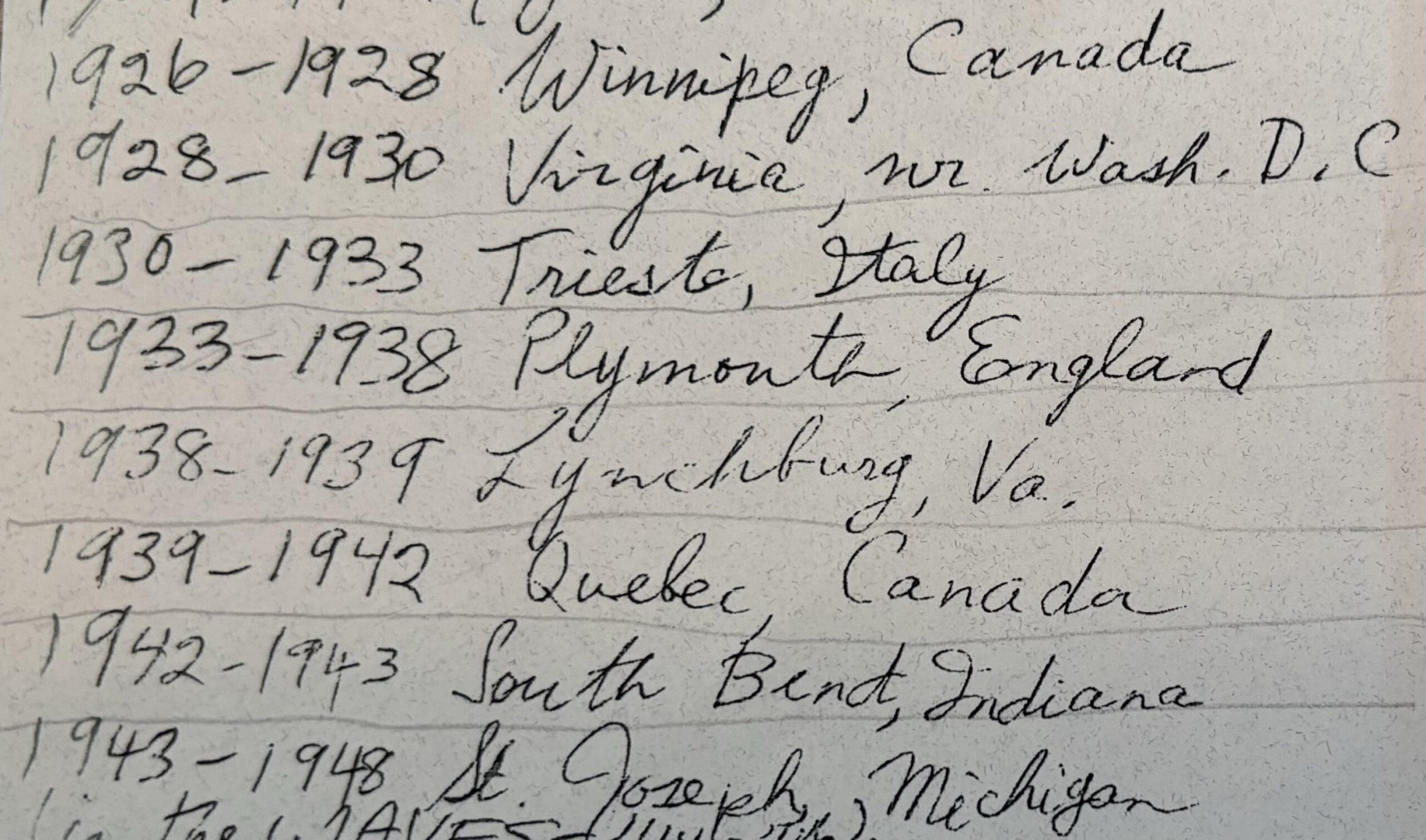
    This list below, created by one of Dad’s sisters, reveals that Dad moved four times in his first 10 years of life. Born in Winnipeg Canada, he then lived in Arlington Virginia, Trieste Italy, and Plymouth England, then later that same year to Lynchburg, VA.

    List of places Don Winslow lived including Winnipeg, Canada, Trieste, Italy, and Plymouth England.
    Dad was born in 1928. He lived in four countries before age ten.

    Where was Ravenswood School?

    The location of Ravenswood School puzzled me. In 1938 Dad lived in two places. Historical sites for Lynchburg don’t show any school by that name, yet four hours from there is the town of Ravenswood, West Virginia. Three schools there had the name Ravenswood.

    I found in my ancestry app that while Dad was at Ravenswood (in January) his grandmother had died in Lynchburg.

    So the Lynchburg timing was right. But wait! But why would they dump him in a school four hours away at age 10, unless it was a boarding school? They didn’t have boarding schools in WV, right?

    Also unusual to me was the inclusion of Latin and French in an American 4th Grade classroom, even in 1938. The wording was weird too: “Form 4” instead of “Grade 4” with the school term was labeled “Easter.”

    I called my lifeline (my brother) who said dad had been in a boarding school at some point in his life. So thinking the town of Ravenswood, WV might be a red herring, I Googled Plymouth, England. Lo and behold, there was a Ravenswood School in England, too.

    Then began a deep dive for me down a dark hole for two days.

    British boarding schools for 8-year olds?!

    That Ravenswood was indeed a boarding school. And from the dates on the report card, I realized Dad had been there at ages 9 and 10. Possibly at even a younger age. WHAT?

    Although my grandparents were American, it was particularly common for children of diplomats and others in working government service in other countries to send their children to boarding schools. The justification for it was that it would supposedly give children more stability and an excellent education.

    But for some reason, I always thought this involved the teen years, not children still clutching teddy bears and wanting mom to read bedtime stories to them.

    Then I found the website Boarding School Survivors: Therapeutic help for those affected by boarding, created by Nick Duffell, also author of the book The Making of Them: The British Attitude to Children and the Boarding School System.

    I was shocked to finally understand one of the lines in tiny print at the bottom of Dad’s report card: “too many stripes for silly behavior and disobedience.” That meant beatings with a cane. I was also distressed reading about how much bullying and even more extreme abuse took place within early boarding schools, meted out by older children.

    Dad, born in February, at the time of this report card was only 10 years and 1 month old, so the report was mostly about his behavior at age 9.

    Boarding school documentaries reveal harsh truths

    I then watched two documentaries on YouTube showing 8 year olds being sent off to boarding school in more recent years. I was disturbed by how it distressed those particularly young children. Leaving Home At Eight | Boarding School Children follows four little girls, and The Making of Them (1994) (also connected with Nick Duffell) several 8 and 9-year-old boys.

    Listening to one little boy in the latter documentary broke my heart. He had quickly learned to shut down his emotions and be a brave little man. Boys who cried for their mothers were particularly targeted for bullying.

    Strangely, those two modern documentaries revealed distress in some of the mothers who felt pressured to send their kids to boarding schools. They were truly persuaded it would be good for them. Some believed it would give their children more stability, what with the family moving often with Dad’s work. Many of these women had husbands who had been in boarding schools themselves, so for the fathers that was all they knew.

    I urge you to watch those documentaries, but with a tissue handy.

    Raising resilient kids at on the move

    This deep dive has me appreciating the permission I always had, being an American, to educate my children in a variety of ways and even when moving to new locations. As a child, I moved every three years: Dad had apparently caught the moving bug.

    I feel that caused growth in me as child and helped me to learn to adapt well. My husband and I while raising our three children lived in three different U.S. states and one other country (Norway.) Of course, it was not always easy for the kids changing schools. But they all grew into adults who love to travel.

    Educationally, depending on each of my own child’s individual needs, we used a variety of methods. Our children experienced a mix of public school (including in Norway) and home school–depending on each one’s individual needs at the time–growing up to be brilliant and loving adults now teaching their own children to explore.

    Fresh understanding

    Now I know more than I wanted to know from a single piece of paper from my vintage paper pile. But it’s got me thinking about my dad and how it may have affected him.

    It also has given me more insight into my Grandmother’s writings about living in British Raj, India. She had commented with some horror on young children being sent away from India to England to boarding schools, while both parents remained in India. Once they were shipped off, some children didn’t see their parents for years. Grandma had come from an extremely tight and loving family, so this shook her.

    I want to weep for all the precious moments British moms missed (as did my Dad’s American mom) with their children in boarding school. Some of you know I wrote a book called Delight in Your Child’s Design (Second Edition, Kindle) so know my passion for that. I can only hope that those moms now know there are ways to educate children well, while keeping them close.