Tag: ancestry

  • Unfolding Grandma’s Secret: An Antique World Map Journey

    Unfolding Grandma’s Secret: An Antique World Map Journey

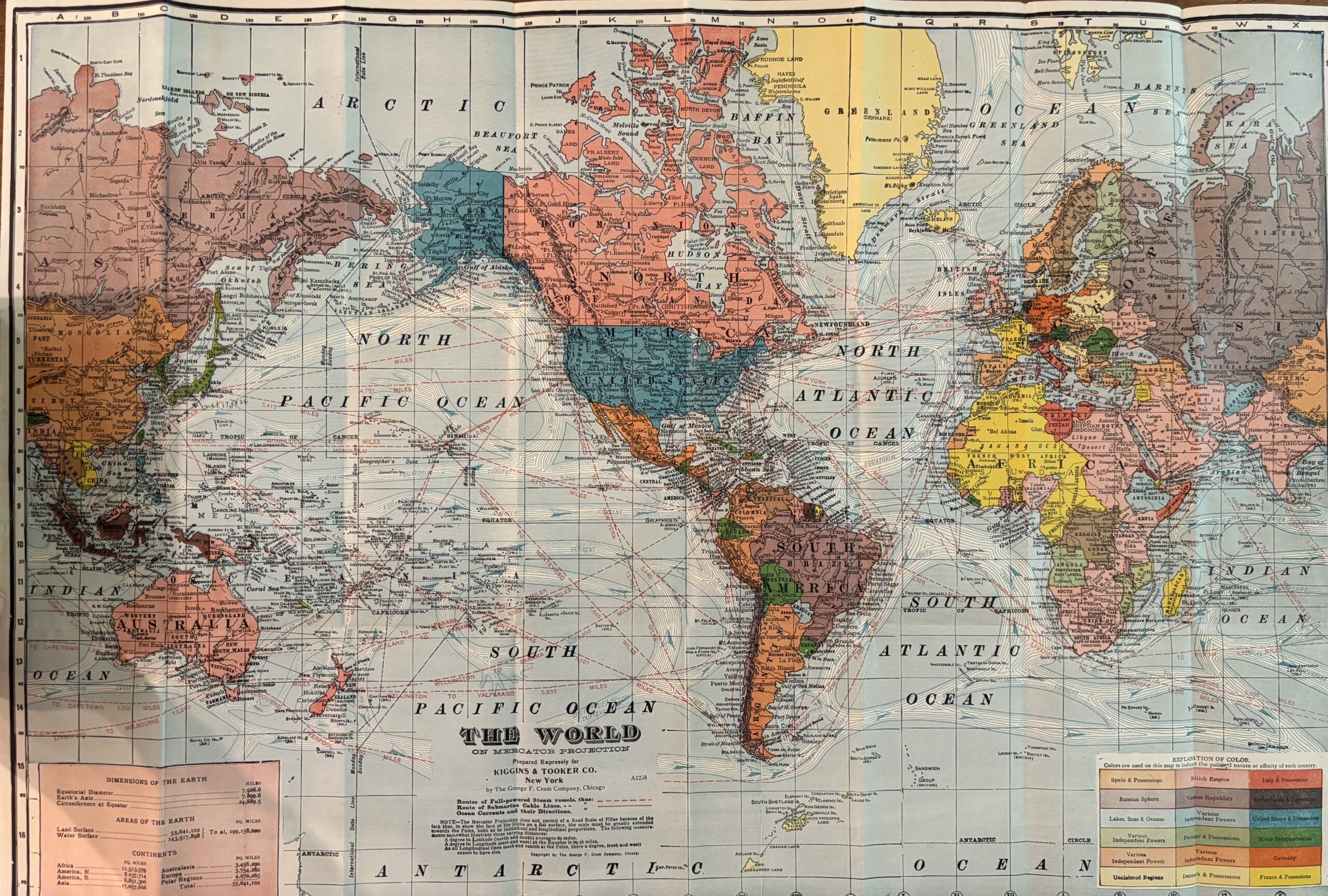
    Today’s exciting find: a historical 103-year-old world map, hidden in Grandma’s steamship travel journal!

    This 1922 antique world map (made by the George F. Cram company, Chicago; for Kiggins and Tooker CO, New York) reveals how far the British Empire and other ruling empires extended. (You can see the color-coding chart, bottom R on the map.)

    The map also includes dashes showing steamship travel paths through the seas.

    This helps me trace where Grandma’s ship sailed and stopped in 1926. The color-coding shows me who ruled the countries she passed through at that time (unless that changed shortly after the map was published.)

    As a bonus, note also the solid lines marked in the seas, indicating submarine cable lines from World War 1.

    (Later in this post you’ll see how the map unfolds from the journal.)

    Sometimes I think my own home is a historical wonderland!

    I have so many boxes of antique handwritten photos, letters, and other memorabilia, it’s easy to lose track of what I have. I joke that I came from a family of hoarders. But I DO relish items hoarded now for over a century which are now in my possession.

    It’s a historical writer’s dream, right?

    For the past year, I’ve searched for such a map online. In the meantime, I had this all along!

    I’m finally working more earnestly on my narrative nonfiction book about the years Gladys Gose Pearce and John Kenneth Pearce lived in India (1923-1933.)

    [My excuse for missing this map: I was temporarily derailed for a few years, assembling and editing a 1950s-1960s collection of vintage scifi short stories, written by yet another family member. See Gremmie’s Reef, now in print.]

    It helps that I’ve now switched my office research piles from vintage science fiction manuscripts back to the India artifacts. So I now have more at my fingertips, including this travel journal.

    Here’s how this antique world map physically unfolds:

    When Gladys wrote in this journal, she’d just begun her steamship journey. It would last 51 days.

    She noted that she boarded the S.S. President Garfield in San Francisco, California in August of 1926. She then had various stops in other countries and ship changes before finally landing in Madras, India to marry Grandpa Ken.

    A bit of their romantic history:

    Ken graduated from high school in Walla Walla, WA with Gladys in 1915. They then both attended the University of Washington in Seattle.

    After college graduation, Gladys went to San Diego to teach.

    In 1923, 25-year-old Ken (J. Kenneth Pearce) was sent to South India, to work as a Forest Engineer for the British Indian government.

    In the fall of 1925, Ken got a short home leave to visit Washington State. He then proposed to Gladys. It was about time! For ten whole years they’d been close friends. But during that visit, sparks flew.

    Gladys and Ken would live in India until 1933: first in South India, and later in the Andaman Islands.

    The Andaman Islands

    The Andamans are tiny specks on this world map, in the Bay of Bengal. The islands are east of the Indian mainland, near Burma (now Myanmar) and Siam (now Thailand.)

    This particular map has the Americas in the center (being published in the USA.) So the R edge of this map shows the mainland of India, while the L edge has the Andaman Islands.

    If you zoom in close you can see where Gladys put an arrow pointing to them. Seeing it on a globe or other-centered map might make it easier to visualize this.

    Still, what a great find this is! I now have this map as my computer screensaver.

    I’m sure the cartographers who drew it 103 years ago could have never imagined THAT.

    What’s in your own attic, basement, or closet? What surprise about your own ancestors awaits you…or have you already found?

    Please share your own discoveries in a comment, or email me via my Contact page. I’d love to hear from you.

    Laurie

  • Calculating Characters in Family History

    Calculating Characters in Family History

    In writing history – family history or a historical biography— using a little math humanizes characters so we can see them as former living, breathing human beings.

    An ancestry chart can provide nuts and bolts about people: birth dates, death dates, marriage dates.  But how can those dates tell a story?

    While researching one interesting true character in my own tree for a history magazine article, I learned the following about a guy named John. Read (but feel free to skim) this next paragraph. I guarantee it’s boring, but a fresher approach follows:

    John Martin Gose (1825-1919) married Hannah Jane McQuown (1831-1925) in 1854. They moved from Missouri to the Washington Territory in 1864 with five children, Thomas Phelps (b. 1855), Dora (b. 1856), Mack (b.1859), John (b. 1861) and Christopher (b.1863). They arrived in Walla Walla in 1865. A sixth child, Oscar (b. 1865 or 1866) was born there.

    With no additional information other than those dates and locations, can we discern more about what this family was like and make their story more interesting?

    1 calculator + 1 family tree = more compelling stories.

    Doing a little math with the dates provided, this picture emerges:

    24-year-old John and his wife Hannah, 22, began their year-long journey on the Oregon Trail with five children all under ten years old. In their covered wagon were Phelps (9), Dora (8), Mack (5), John (3) and Christopher, a nursing baby. After arrival in Walla Walla, Hannah had another child, Oscar — she’d been expecting him either during the during the arduous journey or shortly after arriving in the new settlement. Years later, when the children were teens, tragedy struck. To the devastation of John, Hannah, and the siblings, Oscar died when he was only 12 years old. 

    Although I was able to confirm that yes, they traveled the Oregon Trail, dates and locations alone strongly suggested that initially. All other details in the previous paragraph came from my simply subtracting birth dates from death dates, then imagining what that must have been like for them. Who knew math could tell a story?

    Does this give you an impulse to look at your own ancestral tree in a new way? Eager to find stories about your own family history? Whip out your calculator too! Let me know what stories you discover.

    If you think that’s a fun way to learn about your ancestors, you may like this post, too: A 1915 Yearbook Shows Teen Life 105 Years Ago

  • Finding Stories in Vintage Family Photos

    Finding Stories in Vintage Family Photos

    Are you a writer? A reader? Or a history buff, curious about your ancestors? Regardless, stories intrigue you.  Here’s the first post in my series, Researching Your Own Attic Mysteries. Learn how to dig into your vintage family memorabilia to uncover stories and the personalities behind them.

    I  thought of titling this post “I See Dead People”.

    Not that it has anything to do with apparitions. Instead, it has to do with those Ahah! moments: when images of people in musty sepia-toned images in your attic suddenly become people who intrigue you. With a little digging, you end up seeing them in whole new light.

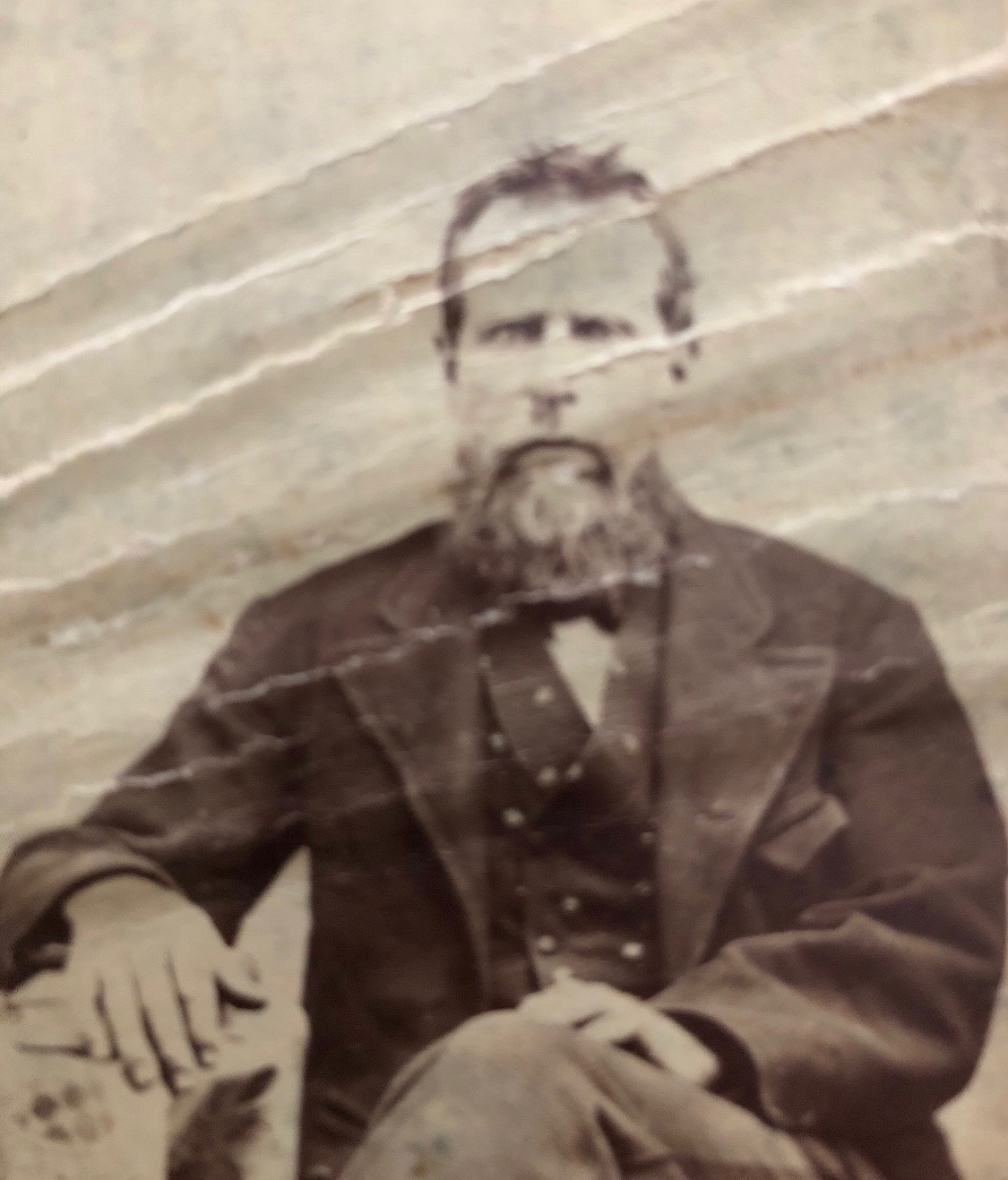
    Take, for example, this image of my great-great-grandpa, John Martin Gose (1825-1919). My grandma’s grandpa.

    IMG-8592

    A year ago, this photo meant nothing to me. Even seeing his name marked on the back meant little. But now I know his story, I’m impressed with this guy!

    What an adventurer he was. He traveled via covered wagon — from Missouri to California — to take part in the gold rush. He then moved back home, started a family, and brought them all on the Oregon Trail. The journey took nearly a year until they settled as as pioneers in early Walla Walla, Washington.

    If that doesn’t beat all, although a farmer, he managed to raise a whole passel of young’uns who became lawyers, a judge and a doctor. All his children prized education so highly that one, my great-grandpa, made sure all his own kids –including four daughters—were university educated before 1920.

    One of those girls, my Grandma Gladys, (1897-1994), was also an athlete. She scandalously swam across a lake at U-Dub in a men’s swimsuit to beat the fraternity guys, became a PE teacher in San Diego, then lived in British Raj India for seven years.

    It seems that apple Gladys didn’t fall far from the family tree — adventurers begetting adventurers.

    Do you now see John, in this photo, a little differently?

    Naturally you’re wondering how I learned so much about him. No, I didn’t make his story up imaginatively out of whole cloth. Playing armchair detective, I combed through a combination of oral family history, online ancestry programs, photos, census records, diaries, and letters. A fuller picture of John emerged. It’s amazing, once you have online tools and documents at your fingertips, how quickly you can pull facts together about people in the past.

    Old census docs contain a lot of cool details, including occupations, i.e. blacksmith or farmer. Perhaps someday your own great-grandkids will look at a census record about you, and say, “I didn’t know great-grandma was a writer!”

    As an author currently writing Gladys’ biography (about her time in India), my exploration of John is more about understanding her backstory. But Gladys is a sum of DNA parts, of her parents and grandparents and their attitudes towards life. It’s nice to not only know her better but also the people who raised her.

    I’ll explain more detail in future posts how to use various resources to uncover fascinating family details, which can be used in nonfiction stories, as elements of fictional characters,  or simply help you learn more about your own ancestry.

    To not miss any future posts here,  subscribe to CrossConnectMedia.com (upper right of this webpage), and follow my Facebook page, (Laurie Winslow Sargent: for Parents, Writers & the Eternally Curious). I’d also love it if you’d join me on Twitter at @LaurieSargent with #MyAtticMysteries.

    I’d love to know if this inspires you to drag some boxes out of your own the attic! Let me know also if you have any questions about this process of exploring old family items.

    Feel free to comment with your own tips on researching family documents, to encourage us all in our fun history explorations.

    Write on!

    Laurie