Authors, one way to get your true personal stories published is through Chicken Soup for the Soul, LLC. Here’s a list of benefits in writing for that company, plus details about a few prolific Chicken Soup story writers.

A Chicken Soup for the Soul story is an inspirational, true story about ordinary people having extraordinary experiences. It is a story that opens the heart and rekindles the spirit. ” ~ chickensoup.com
I recently was published for the fifth time by this company, including back when the imprint was HCI (Health Communications, Inc.) with Mark Victor Hansen and Jack Canfield. Now CCS (Chicken Soup for the Soul, Inc.) is headed up by Amy Newmark.
However, I “ain’t nuthin’ ” compared to other prolific Chicken Soup writers in my one small North Carolina critique group. Our group has so many published stories (29 stories, so far, with more in the works) our group has been dubbed “The Chicken Coop”.
The decided winner so far, in number of published stories from our group, is Nancy Emmick Panko with 14 CSS stories. The other 15 stories are spread out among five more of us: Terry Hans, Barbara Bennett, Dea Irby, JoAnne Check, and myself. (I’ll share a list of their stories in a moment and links to books they were in.) But part of that success is our group’s familiarity with what “makes” a Chicken Soup story, and what doesn’t.
Be sure to read at the chickensoup.com website their writer’s guidelines for submission. They receive so many submissions, competition can be tough. In our group we’ve also submitted other stories that didn’t make it. Only 101 stories are chosen per book, after many other submissions are weeded out so it’s truly an honor to be included. The stories go through selection rounds until it gets down to the final 101.
Here are some advantages to writing for this publisher:
- It’s a great way to be in a book without having to write a whole book, and you get into print fairly quickly.
- Author bios at the end of the book are generous, and can include author book titles and contact info.
- Payment is nice: $200 for stories (up to 1200 words long). They also currently send 10 free copies of the book, plus discounts on more to sell if you like.
- The company is great about suggesting ways to promote the books and engaging their authors in that. One current way is through Twitter parties. The also have a digest just for their authors to spotlight how some are helping promote the books.
- It’s a great way to get a story of yours visible by many more readers than one of your own books might generate — stories you want to encourage as many people as possible. (This has been my favorite benefit, because I love to share stories about amazing ways God has answered prayers.)
- It builds your author credits and helps readers become familiar with your author name.
How to submit to Chicken Soup for the Soul:
Check out Chicken Soup for the Soul’s Possible Book Topics page with current titles the publisher is seeking submissions for. It’s kept updated, with deadlines and usually has 3-5 books in the works. There’s an additional tab to submit your story right there online. (Edit it first –maybe with your own critique group!)
But WAIT! Bookmark this page so you can check out these Chicken Soup titles, some you may already own, and read stories by my group members who I’m so proud of.

- Laughter is the Best Medicine (2020) ~ Terry Hans, “My Hallmark Moment”; Nancy Emmick Panko, “Stuck in the Ceiling”
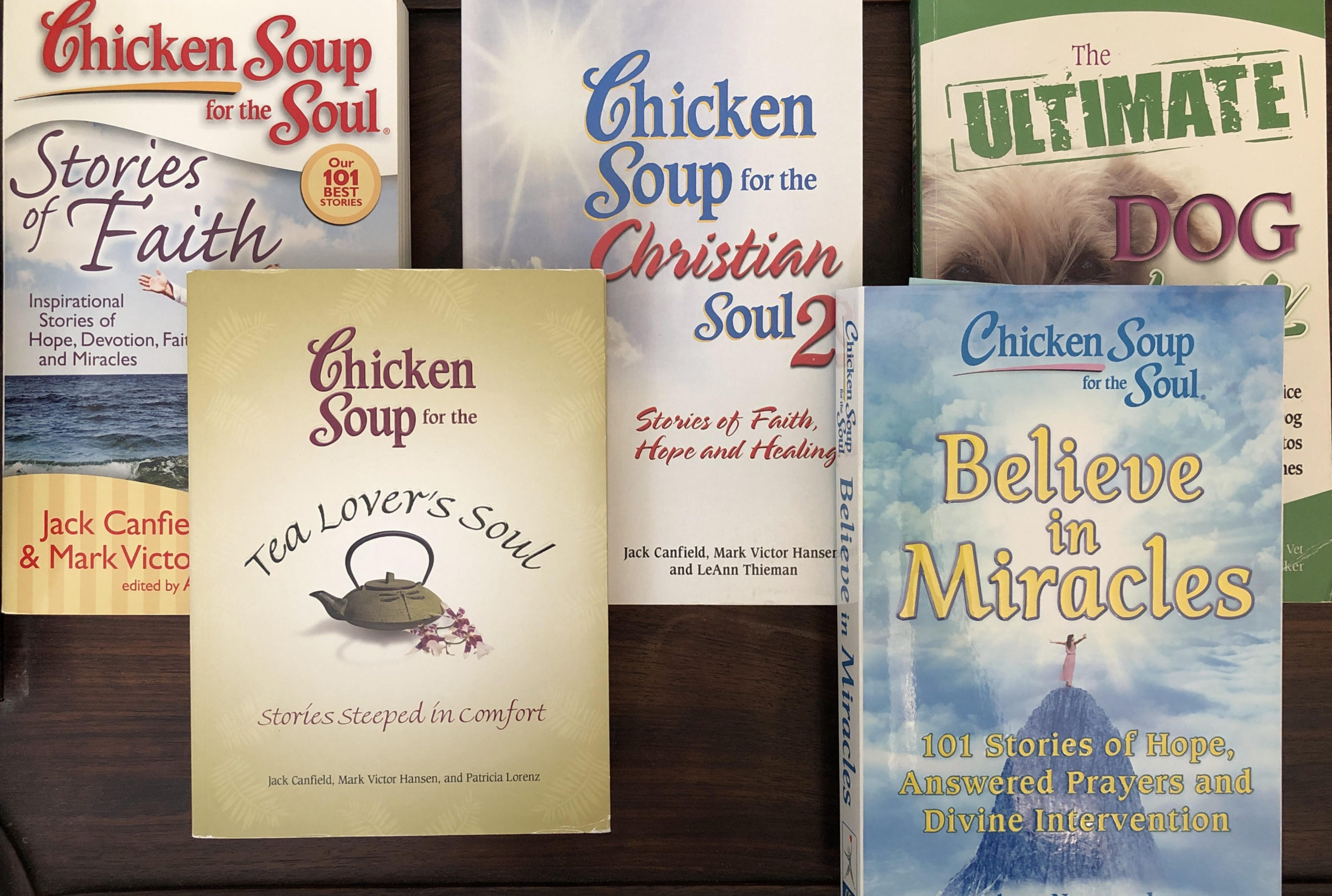
- Believe in Miracles (2020) ~ Nancy Emmick Panko, “How to Upstage a Bride” and ‘St. Gerard and Me”; Laurie Winslow Sargent, “Iowa Signs”
- Messages from Heaven and Other Miracles (2019) ~ Terry Hans,”Checking In”; Nancy Emmick Panko, “Together Again”; Barbara Bennett, “My Man and the Sea”
- Grandparents (2019) ~ JoAnne Check, “Wrapped Around my Heart”
- The Forgiveness Fix (2019) ~ Dea Irby, “Sweep Away”
- Angels All Around (2019) ~ Barbara Bennett, “Divine Comfort”
- It’s Beginning to Look a Lot Like Christmas (2019) ~ Nancy Emmick Panko “No Room at the Inn”
- My Crazy Family (2018) ~ JoAnne Check, “A Basket Full of Trouble”
- The Best Advice I Ever Heard (2018) ~ Nancy Emmick Panko, “Don’t Drink the Poison”
- Step Outside Your Comfort Zone (2017) ~ Dea Irby, “Moving”
- My Kind of America (2017) ~ Nancy Emmick Panko, “A Cast of Characters”
- Best Mom Ever (2017) ~ Nancy Emmick Panko, “Mom’s Macaroni Money”
- Step Outside Your Comfort Zone (2017) ~ Barbara Bennett, “Stand Up”
- Angels and Miracles (2016) ~ Nancy Emmick Panko, “The Brown Glass Fish” and “My Interstate Navigator”
- The Joy of Less (2016) ~ Nancy Emmick Panko, “Nun the Worse for Wear”
- My Very Good, Very Bad Dog (2016) ~ Nancy Emmick Panko, “Amazing Onyx”
- The Joy of Christmas (2016) ~ JoAnne Check, “Reality Check”
- Hope and Miracles (2015) ~ Nancy Emmick Panko, “The Last Dance”
- Find Your Inner Strength (2014) ~ Nancy Emmick Panko, “A Journey of Healing”
- Chicken Soup for the Tea Lover’s Soul (2007) ~ Laurie Winslow Sargent, “A Peppermint Tea Miracle”
- Stories of Faith: Our 101 Best Stories (2008) ~ Laurie Winslow Sargent, “Southbound Miracle” (reprint of story also published in Chicken Soup for the Christian Soul 2 (2005)
By the way, another book, The Ultimate Dog Lover (2008) was a spin-off book by HCI, so not technically a Chicken Soup book. It’s worth mentioning because another terrific thing this publisher does is send requests to their existing authors for more material. Sometimes that’s an email with more detail about needs for upcoming books. However, in this case, it was a request for photos. My beloved dog Nikki earned a full-page in the book; her photo happened to be on my computer desktop the day I got the email request. Very serendipitous.
You might enjoy our joint Bio at the end of that book, which became its own story:
Laurie Winslow Sargent is an author specializing in family play–including play with her four-year-old miniature American Eskimo Mix, Nikki. Nikki loves soccer (catching the ball in the air with her front paws, dribbling, and blocking on command) and bounce-passing a basketball. She wipes her feet on a mat (for a treat!) and hops into her crate when she hears the AOL “Good-bye!”. Best of all, when her family returns from work or school, Nikki greets them with and excited “Hi!” The sound initially occurred as a yawn, that coincidentally sounded like the word.
That AOL reference is a clue to how long we ladies have been writing!
Your turn! Write On.