Blog

  • Dilemma of the Multi-Genre Author

    Dilemma of the Multi-Genre Author

    It’s great fun for a writer to wear many different hats: to write effectively on a variety of fun topics. It keeps life interesting. But how does the multi-genre author effectively manage their brand, website, and social media pages?

    That’s a trick I confess I’ve yet to manage properly. I’d love reader feedback on this dilemma!

    When I began writing, it wasn’t quite so tricky. My first website I managed myself was in the 90s, on Tripod (no longer in existence, but oldies may remember it) under my author name.

    Next came WordPress blogging. For parents, I had (have) my Parenting by Faith blog. For writers, it was (is) my Sell Your Nonfiction blog, on how to sell magazine articles. My articles on parenting and writing are still there; most on perennial topics, thankfully.

    Well eventually my old WordPress themes became unsupported: the graphics went wacky. The switch from free WordPress.com to fee supported WordPress.org made sense, for more personal control over my material. The creation of CrossConnect Media to merge (ideally) all the weird parts of my brain on one site seemed possible. I chose the Get Noticed Theme, which had/has quite a learning curve. (It is no longer supported by the designer, but still seems to work … for now).

    NOW here I go, turning into a history nut! At least a nut revolving around 95-year-old letters found in my own attic, written from an American mom in the Indian jungle, a remote island convict colony with an elephant logging camp in the 1920s. How could that NOT be irresistible to a writer?

    So here I am. As if my sites are not complicated enough. It may not be as much a disconnect as it seems: a good portion of the historical biography I’m writing has to do with motherhood. And writing, of course. But if I’m not careful, this website could turn into a very strange medusa.

    For now, I just keep running my old blogs and hope my social media pages add clarity to what I do, in addition to my Bio. History buffs may enjoy my Facebook page, Laurie Winslow Sargent: for Parents, Writers and the Eternally Curious with links to my Twitter page. There I’m posting some fun historical tidbits related to my research of the 1920s-1930s in British Raj India. Here, I will continue to post tips on the writing business.

    If, perchance, you are a multi-genre author like myself and have successfully figured out a one-size-fits-all website for yourself, I’d love to hear about it!

    Laurie

  • Finding Stories in Vintage Family Photos

    Finding Stories in Vintage Family Photos

    Are you a writer? A reader? Or a history buff, curious about your ancestors? Regardless, stories intrigue you.  Here’s the first post in my series, Researching Your Own Attic Mysteries. Learn how to dig into your vintage family memorabilia to uncover stories and the personalities behind them.

    I  thought of titling this post “I See Dead People”.

    Not that it has anything to do with apparitions. Instead, it has to do with those Ahah! moments: when images of people in musty sepia-toned images in your attic suddenly become people who intrigue you. With a little digging, you end up seeing them in whole new light.

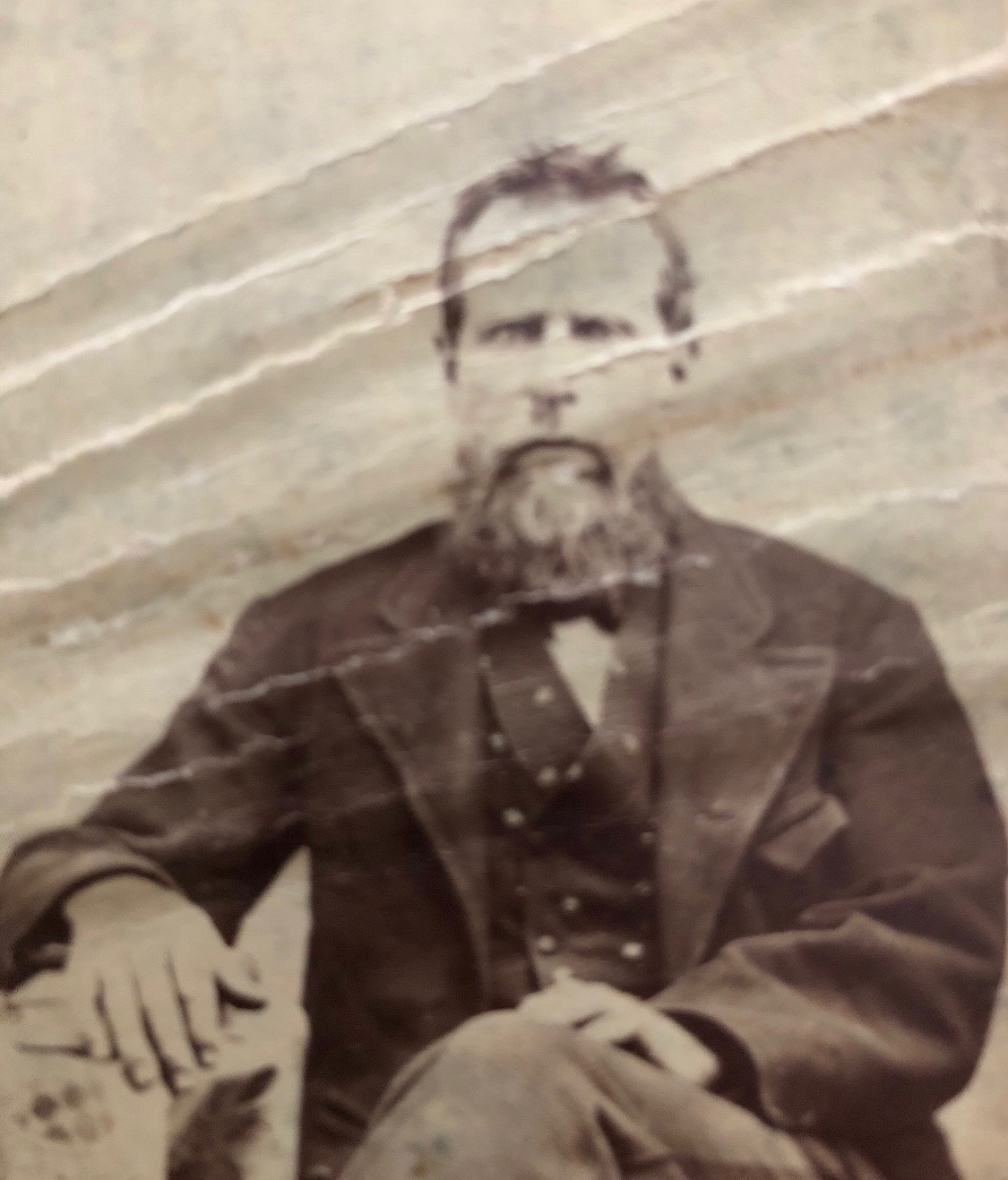
    Take, for example, this image of my great-great-grandpa, John Martin Gose (1825-1919). My grandma’s grandpa.

    IMG-8592

    A year ago, this photo meant nothing to me. Even seeing his name marked on the back meant little. But now I know his story, I’m impressed with this guy!

    What an adventurer he was. He traveled via covered wagon — from Missouri to California — to take part in the gold rush. He then moved back home, started a family, and brought them all on the Oregon Trail. The journey took nearly a year until they settled as as pioneers in early Walla Walla, Washington.

    If that doesn’t beat all, although a farmer, he managed to raise a whole passel of young’uns who became lawyers, a judge and a doctor. All his children prized education so highly that one, my great-grandpa, made sure all his own kids –including four daughters—were university educated before 1920.

    One of those girls, my Grandma Gladys, (1897-1994), was also an athlete. She scandalously swam across a lake at U-Dub in a men’s swimsuit to beat the fraternity guys, became a PE teacher in San Diego, then lived in British Raj India for seven years.

    It seems that apple Gladys didn’t fall far from the family tree — adventurers begetting adventurers.

    Do you now see John, in this photo, a little differently?

    Naturally you’re wondering how I learned so much about him. No, I didn’t make his story up imaginatively out of whole cloth. Playing armchair detective, I combed through a combination of oral family history, online ancestry programs, photos, census records, diaries, and letters. A fuller picture of John emerged. It’s amazing, once you have online tools and documents at your fingertips, how quickly you can pull facts together about people in the past.

    Old census docs contain a lot of cool details, including occupations, i.e. blacksmith or farmer. Perhaps someday your own great-grandkids will look at a census record about you, and say, “I didn’t know great-grandma was a writer!”

    As an author currently writing Gladys’ biography (about her time in India), my exploration of John is more about understanding her backstory. But Gladys is a sum of DNA parts, of her parents and grandparents and their attitudes towards life. It’s nice to not only know her better but also the people who raised her.

    I’ll explain more detail in future posts how to use various resources to uncover fascinating family details, which can be used in nonfiction stories, as elements of fictional characters,  or simply help you learn more about your own ancestry.

    To not miss any future posts here,  subscribe to CrossConnectMedia.com (upper right of this webpage), and follow my Facebook page, (Laurie Winslow Sargent: for Parents, Writers & the Eternally Curious). I’d also love it if you’d join me on Twitter at @LaurieSargent with #MyAtticMysteries.

    I’d love to know if this inspires you to drag some boxes out of your own the attic! Let me know also if you have any questions about this process of exploring old family items.

    Feel free to comment with your own tips on researching family documents, to encourage us all in our fun history explorations.

    Write on!

    Laurie

  • Starting Small: Writing Your First Magazine Article

    Starting Small: Writing Your First Magazine Article


    Do you have an urge to write, but have not yet started  — and can only imagine writing a whole book someday? Someday when you are less busy? Or when you know more about writing?

    Try Nonfiction Article Writing

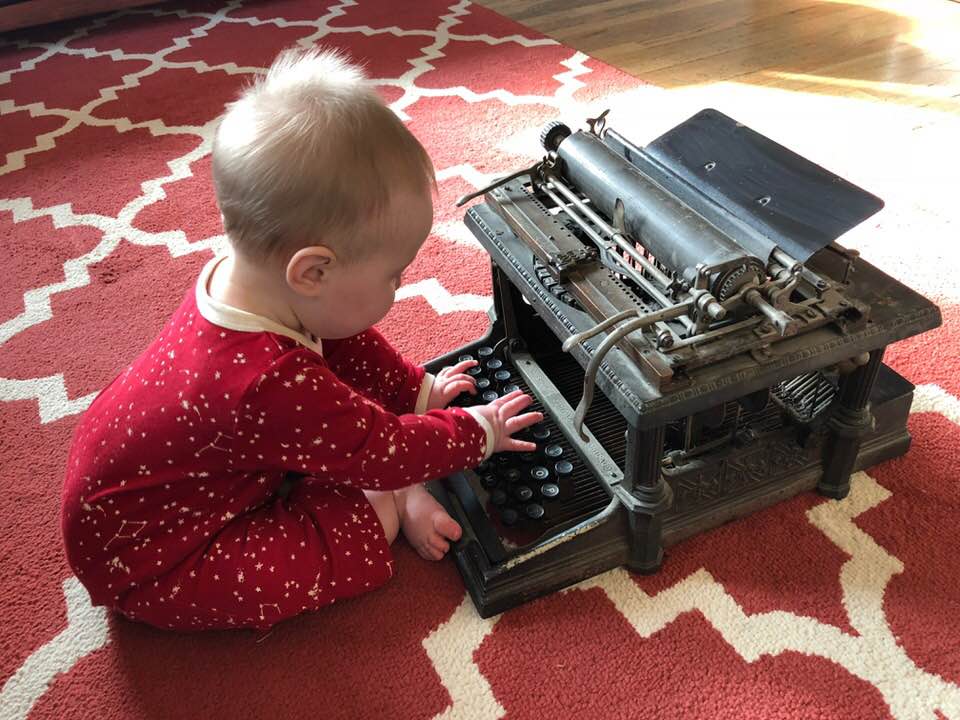
    Think smaller, and you can start writing earlier than later.  Perhaps not as early as the author in this photo (my brilliant 8-month-old Grandbaby Lu). But earlier, as in NOW.

    The key is to write something short and sweet: a magazine article, for example. Nonfiction articles (which can include true personal experience stories) are a great way to dip into the writing world. Articles can also produce income for the long haul. One can be sold more than once, included in book material later, then used as a book excerpt to help promote that book. With one article you can reach hundreds of thousands of readers at one time, unlike most books.

    Granted, it does take three things: finding one great idea, finding the right audience & magazine, and writing your article well.

    As for finding an idea, I’m willing to bet you’ve had one stirring about in your mind, but haven’t been sure what to do with it. Most people who want to write have some idea they are wrestling with already. What shape could that take? An inspirational or dramatic Chicken Soup style story? A how-to article? An interview or investigative piece?

    Finding the right audience and magazine in which to be published requires some exploration. Laurie’s Lessons  can help. In blog posts at SellYourNonfiction.com I share some information I’ve taught for decades through writing workshops at community colleges and writers conferences.  Those posts explain a bit about how the magazine writing world works, including how to find and contact editors, how much articles pay, etc.

    As for writing well: that’s an ongoing process. If you struggle with grammar, you will obviously need to get a leg up on that before trying to write professionally. But if you are reasonably proficient with words and willing to be a continuous learner, a writing critique group can help tremendously. There  are also great books and magazines available through Writer’s Digest addressing all aspects of the writing process.

    The nice thing about starting small, with perhaps a single article, is that you can learn about the entire publishing process in a nutshell. You will learn how to write an article proposal, acquire and meet a deadline, work with editors, then get to see the finished piece in print, which for a first-time author is a thrill. That whole process might take a few months or a year, depending on the publication.

    Just don’t let little Lu beat you in getting published; she has a good head start on you!

    Laurie

  • One SWEET Magazine Article Writing Assignment

    One SWEET Magazine Article Writing Assignment

    How in the world did I, a freelance writer in the USA, get the amazing opportunity to interview a Norwegian Olympic athlete? In her own home, about a sport I’d never heard of, in a country I had never visited?

    Cover of 1994 Viking Magazine with magazine article written by Laurie Winslow Sargent on Lillehammer athlete Hildegunn Fossen

    Think creatively about how to find your next freelance magazine article writing assignment:

    In 1990’s, my husband’s company in the USA was bought by Norwegians, so he traveled there frequently on business. When I had an opportunity to visit Norway with him, and I was thrilled!

    I wondered if I might be able to garner an article assignment related to the trip. A family member told me about Viking magazine, for Sons of Norway members (people interested in Norwegian heritage) so I called the editor. She was responsive to my experience writing for other national magazines.

    The editor asked if I’d be open to interviewing a Lillehammer Olympic athlete. (Of course!) She suggested that I contact the Lillehammer Olympic Organizing Committee. That led me to Hildegunn Fossen, a 24-year-old female biathlon (ski shooting) champion. A dynamite skier and a crack shot with a rifle, she had won the 1993 Norwegian national biathlon competition and was preparing for the 1994 Winter Olympics.

    Unbelievably, in Drammen Norway we dined with a coworker who knew Hildegunn. She had been born in his city! I was told exactly where she lived, on a farm several hours away in the mountains. Serendipitously (actually I call it a God-thing), our plans already included a train journey on the Bergen Railway across the country to see the fjords. Hildegunn lived along the way!  I was able to use our preexisting train ticket, but simply hop off for a few hours, then back on. She lived only 12 minutes away from Bromma train station and fetched me to take me to her home.

    For those as uniformed as I was: the biathlon for the winter Olympics is combination of skate style skiing (skoyting) and target shooting. In Norwegian, ski shooting is called ski skyting, pronounced “shee sheeting.”

    Hildegunn told me that as soon as she had began walking, her folks had put her on skis. At around age twelve she learned to use a rifle. At the time of our interview, she was spending ten days a month on the slopes, practicing or traveling with the national team to competitions in Austria, Yugoslavia, Italy, and Germany. Home training included  jogging, weight lifting, mountain biking, use of road skis (short skis on wheels) on pavement, and target practice.

    Curious about ski shooting? Here’s what I learned:

    During a 7 1/2 kilometer ski run, the athlete (with a rifle slung over her back) has two opportunities to stop and shoot at targets 50 meters away–once while standing, the other while laying flat on a pad on the snow. The rectangular target has five holes spaced evenly. The athlete, whose rifle is loaded with only five bullets, must shoot through the center of every hole in the target. For each miss a penalty loop of 150 meters must be skied. Finishing times vary from race to race depending on wind, snow and track conditions, and how well the skis are waxed. When it is snowing hard, the athletes wear goggles, raising them to shoot while peering through the swirling snow. A flag near each target helps alter sights on the gun to compensate for wind conditions.

    Hildegunn demonstrated her shooting skills for me outside her home, then showed me various interesting awards she’d been given. Most were lovely but practical objects, including a carved clock and a lovely silver goblet from King Harald.

    Before I left, I was also given a tour of the farm. Their sheep would graze throughout the summer, in the hills, until rounded up in the fall. The family would shear them, sell the wool, and birth the lambs. I was amused at how when Hildegunn approached the meadow and called out, some lambs came running like puppies, bleating excitedly. One mama had been lost to a lynx so Hildegunn had bottle-fed the weakest lamb.

    Bromma NorwayAfter a wonderful visit,  I hopped back on the train to catch up with my husband.

    As our journey continued, we got to see the incredible Hardanger Fjord, then traveled on down to Haugesund, Norway.  Unbeknownst to me at the time, we’d later live in Haugesund for two wonderful years and have the adventure of a lifetime.

    I realize now how grateful I am that Hildegunn spoke English so well. When we moved to Norway I faced some challenge in not being able to communicate well — especially difficult for a word person! You can read  On Being an Illiterate Writer to see how that temporarily affected my identity as a writer, but it also highly sensitized me to how expats from other countries may feel when they come to the USA if English is not their native language! And they may be even be expert writers in their own language.

    It’s so odd to think that I can now read news about Hildegunn in Norwegian, and understand a bit of it, something I never dreamed of when I first I picked up that phone to call Viking magazine!

    Also, at the time I called to see about a magazine article assignment with Viking, I wasn’t aware of any Norwegian heritage in my own family. And then my youngest daughter was born there, beginning our own heritage there. And to top it off — she’s an athlete too, now heading off to a college in the mountains to run cross-country and looking forward to skiing too.

    And of all things, here it is 22 years later and I and Hildegunn, now with her own family, are connected on Facebook. She posts her family news in Norwegian, and thankfully I can understand some.  You just never know where a magazine article assignment will lead you and the long-term connections you may make because of that!

    This video from Rick Steves brings back memories of our Norway in a Nutshell train ride on the Bergen Railway! (Makes me crave that brown goat cheese that tastes like caramel–yum!) Enjoy the virtual ride.