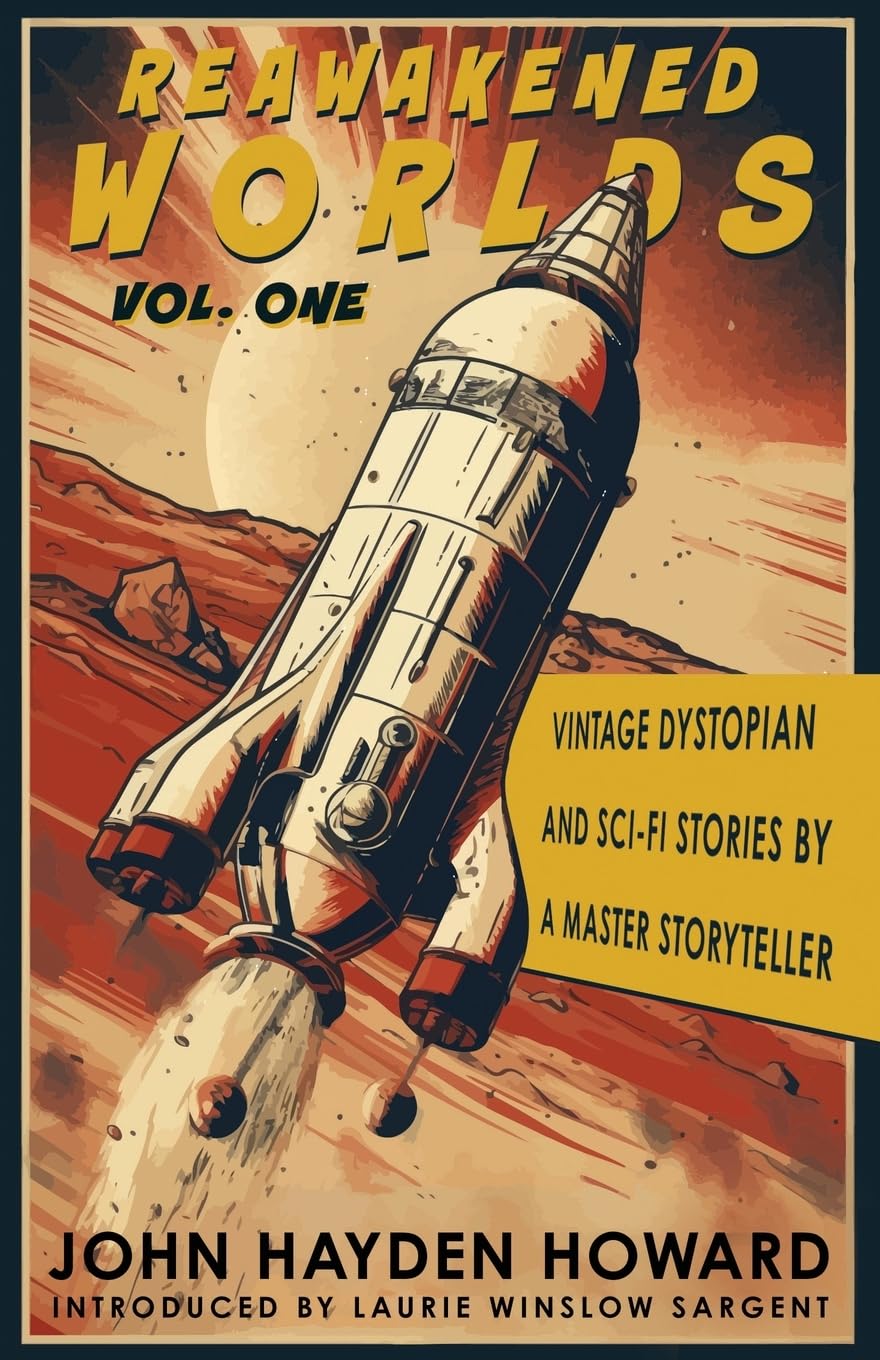
In 1954, John Hayden Howard sold a story to Ellery Queen’s Mystery Magazine for $400

The Dipping of the Candlemaker was one of 18 mystery and detective stories Hayden Howard had published in the US, UK, and Australia.

Later in the 1960s, he became a popular science fiction author.

In 1954, the average pay for teachers was around 4K per year. A short story author, selling at least ten stories a year, could at least earn the meager pay of a teacher. (Howard in his later years also became a teacher, in Santa Barbara CA.)

Scott Meredith was John’s literary agent at the time. Here’s a letter from Scott about the sale of John’s Candlemaker story.

Interesting facts: 1) Ellery Queen was a pseudonym for the writers/publishers Fred Dannay and Manfred Bennington Lee. 2) It may interest science fiction fans that Scott Meredith also represented Arthur C. Clarke and Philip K. Dick.

In the letter above, written 70 years ago, Scott asked John to give the story more “stature” before publication. I haven’t the foggiest idea what that meant! But perhaps John did: it was published/republished five times.

Now I wonder even more what “stature” meant in 1954, so I can “get me some of that good stuff” for my own writing!

What’s especially interesting to me is that this particular story is a quirky one, compared to everything else Hayden Howard wrote. He set The Dipping of the Candlemaker in a 1600s colonial village. His characters spoke in 17th century English.

How did Hayden know how to write that? Back in ’54, did he peruse vintage documents in a library, to get the hang of 1600s lingo?

It’s especially hard to imagine the Candlemaker story was by the same author who wrote the sci-fi stories I compiled for the new Reawakened Worlds anthologies!

Then again, in his elder years, Hayden, AKA John, AKA Jack wrote poetry, including love poetry to his wife. So he was certainly a versatile writer, and full of surprises. He lived until his eighties, but was only in his twenties when he wrote The Dipping of the Candlemaker.

Here’s a list of 18 detective, mystery, and sea stories written by Hayden Howard.

Blood on the Medicine Arrows: The Saint Detective Magazine, December 1956; The Saint Detective Magazine, (Australia) July 1957; The Saint Detective Magazine (UK) September 1957

City in the Bottle: The Saint Mystery Magazine, April 1959; The Saint Detective Magazine, (Australia) June 1959; The Saint Detective Magazine (UK) August/September 1959; The Saint Mystery Library #2, 1959

Dead Beat: Manhunt, October 1960

Denny: Popular, 1954

Down Among the Rock Cod: Tales of the Sea, Spring 1953

Finger in the Trough: The Saint Mystery Magazine, April 1960; The Saint Mystery Magazine, (UK) June 1960

Hellwater Run: Adventure, March 1953

Murder on El Capitan: Keyhole Mystery Magazine, April 1960

Murder on San Afer: The Saint Detective Magazine, October/November 1953; The Saint Detective Magazine, (Australia) October 1954; The Saint Detective Magazine, (UK) December 1954

Murder Without Tears: Fifteen Detective Stories, August 1953

Pass the Bottle: Ellery Queen’s Mystery Magazine #123, February 1954; Ellery Queen’s Mystery Magazine (Australia) #82, April 1954

Shark: Jack London’s Adventure Magazine, December 1958

The Amateur Assassin: The Saint Detective Magazine June 1957, The Saint Detective Magazine (UK) April 1958; The Saint Mystery Library #1, 1959; Great American Publications, Inc. August 1959

The Big Word: Trapped Detective Story Magazine, June 1956

The Dipping of the Candlemaker: Ellery Queen’s Mystery Magazine, October 1954; Ellery Queen’s Awards: 9th Series ed. Ellery Queen, Little Brown, 1954; Ellery Queen’s Mystery Magazine (UK) #21, October 1954; Ellery Queen’s Mystery Magazine (Australia) #90, December 1954; the hardcover book Mystery and Murder in Boston, W.W. Norton and Company Inc. 1987

 The Dummy and the Death Web: New Detective Magazine, April 1953

 The Housemother Cometh: Manhunt, December 1954; Giant Manhunt #5, (var.1), #5 (var.2) 1955

The Old Man’s Last Case: Popular Magazine, abt1954.

The Wrong Man: The Pursuit Detective Story Magazine #4, July 1954; Pursuit—The Phantom Mystery Magazine, May 1955

With His Back Turned: The Saint Detective Magazine August/September 1953; The Saint Detective Magazine (Australia) March 1955; The Saint Detective Magazine (UK) May 1955

NOTE: Friends, if you come across copies of any of these magazine issues, let me know! I have collected some but not all. As for you fans of Hayden Howard’s sci-fi: does it surprise you that he wrote mysteries, too?

Grandpa and the Maharaja of Jaipur

The book The Henna Artist (by Alka Joshi) includes scenes set in the Indian palace of the Maharaja of Jaipur. That brings alive a 1920s invitation in my possession–from that maharaja to my American grandfather, J.K. Pearce.

This is an invitation to my grandfather from His Highness the Maharaja of Jaipur. The location and time: At Home (the palace) June 1st at 4 P.M. (most likely a year between 1923 and 1926.) The event was a Gymkhana (featuring races and competitions) on the Horse Show Lawn.

While this seems a huge departure from my recent blog posts on vintage sci-fi and Reawakened Worlds, it’s not quite the stretch you imagine. Yes, 1920s historical nonfiction and 1960s science fiction are different genres. But what they have in common is the past.

The connection between the two genres is an abundance of artifacts inherited from my own family. They surround me in my home office.

On one hand, I possess vintage science fiction manuscripts, author-agent letters, and magazines (Galaxy, IF, and others) with short stories written by my stepfather in the ’60s.

Yet I’m also surrounded by 1920s ephemera. That includes photos, film reels, diaries, letters, and unusual objects from my maternal grandparents’ time in British Raj India (1923-1933.)

Sometimes I can’t recall which time period I’m in, particularly 2024!

But back to how Grandpa met the Maharaja of Jaipur, and why a young American man from Washington State was in India to begin with…

Grandpa studied Forest Engineering at the University of Washington, then as an associate professor attended the Pacific Logging Conference. There he met a man who was working in the logging industry in India. That man encouraged my grandfather Ken (J. Kenneth Pearce) to apply for, take over, and expand his position.

So at about age 26, Ken was hired by government of India (then under control of the British.) He assumed a position of high authority in South India which he held for ten years. His job was to oversee elephant logging camps, introduce machine power into the camps, and help establish sawmills. At times he also functioned as a district magistrate.

In India, Ken he was called Sahib and Master Pearce, and Grandma Gladys was his Memsahib.

That felt awkward to them at times. There was great pressure for them to hire many servants. Yet both of my grandparents were highly industrious, hard-working people. They often simply wanted to do the work themselves.

Grandpa worked from sunup to sundown, often shoulder-to-shoulder with his Indian laborers (most who were ex-convicts.) Grandma sewed clothes for herself and Ken. As a physical education teacher, she was hired to evaluate physical education programs in schools in Madras and other cities.

As for the Maharaja of Jaipur–I believe this particular invitation was for just Ken, before Grandma Gladys sailed to marry him in 1926. Then Ken and Gladys lived in Tamil Nadu region until 1929, primarily in Madras (Chennai) and Ooty. (1930-1933 they lived in the Andaman Islands.)

Ken managed logging camps throughout South and Southwest India. The University of Washington archives hold artifacts related to the forestry work of J.K. Pearce in India. However, I hold all his personal mementos from that time and place, plus additional logging ephemera.

Grandma also met a maharaja: the Maharaja of Mysore, who had a summer palace in Ooty (the Fernhills Palace.)

Gladys wrote of a funny (or disconcerting?) event that took place on the palace lawn. Before moving to India, she had saved money from her job as a junior high physical education teacher. On the steamship ride over, during a stop in Asia, she bought her first set of pearls and treasured them.

At the palace, a young child (one of the princes) approached her bedecked with jewels. He pointed at her pearls and demanded to have them. As you can imagine, she clutched them, and gave him a firm “No.” She had worked too hard for those!

We Specialists: a sci-fi story in the Reawakened Worlds, Vol. 1 anthology

(John) Hayden Howard wrote his fictional short story We Specialists in 1967: three years after a horrific crime had been reported in the newspapers. Sixty years later, that case–and its reported “bystander effect”–is still discussed in countless psychology classes.

Page 60 of Reawakened Worlds,  with the story We Specialists, by John Hayden Howard. Story written in 1967,

While Hayden couldn’t possibly have known that specific case would still be discussed sixty years later, it’s obvious it impacted him at the time. I know I never forgot the story from my own psych classes in the late 1970s. Imagine my surprise when I found something similar among Hayden Howard’s yellowing manuscripts.

I nearly missed the association with his character’s futuristic name: Kitty G-3, because he makes no mention of any news story. As with Hayden’s usual subtle style, he simply tells a story and lets readers experience their own “ah-hah!” moments.

For those of you unfamiliar with the original crime and hate spoilers, of course avoid Googling it. You can read John Hayden Howard’s sci-fi story in Reawakened Worlds Vol 1 before exploring the related news story. In the meantime, I’ll share no more details of the original crime previously mentioned!

Let’s focus instead on the underlying message in Hayden’s story:

Even in the distant future, no matter how high-tech that may be, I hope people will learn to all look out for each other. That, I’m sure, is the message Hayden meant to convey in We Specialists. That we can’t make excuses for not helping strangers, even if the government (as in his fiction story) were to attempt to box us into specific roles. That we should never become so desensitized to violence that we focus only on ourselves or on rules or laws.

Yes, this brief short story is one of violence. I’m not a fan of anything truly gory, but I’d give this short story a PG 13 rating for violence, as he focused more on the ridiculousness of allowing ourselves to be confined by roles that exclude helping others. Showing that ridiculousness, his last line referring to a Homicide Specialist is a real kicker.

About John Hayden Howard:

John Hayden Howard was well-known in the 1960s for his science fiction writing (see the International Science Fiction Database) but also had published many mysteries and detective stories, in magazines including Ellery Queen’s (originally called Ellery Queen) mystery magazine. Perhaps Hayden saw “We Specialists” as a bit of a crime and sci-fi genre merge. Here’s where you can find the story (one of eight):

To read descriptions of some of his other stories in Volume One, see my former posts on:

The Tragedy of Henry Diddoh: a 1950s Frankenstein-ish story in Reawakened Worlds

Gremmie’s Reef: in Reawakened Worlds Vol 1

Hayden Howard: Short Stories with Creative Wordplay (featuring “Ten Rounds for the All-Time Champ”)

More stories to come!

Volume Two of Reawakened Worlds, MORE Dystopian and Sci-Fi Short Stories, is slated for release in September, with pre-ordering soon! Here’s a sneak peek at the cover of book 2! Contact me (or Subscribe) to know the moment it’s released. And as always, I’d love to read your comment below. Let me know if you’ve read Volume One and how it grabbed you!

Gremmie’s Reef: in Reawakened Worlds Vol 1

In Gremmie’s Reef–a 1964 science fiction short story in the anthology Gremmie’s Reef: Classic Sci-Fi Short Stories from the 1950s and 1960s (formerly titled Reawakened Worlds) by (John) Hayden Howard–a teen surfing off the Santa Barbara, California coast finds something bizarre.

Previously published in If Worlds of Science Fiction, October 1964 (illustrated by Finlay) the story Gremmie’s Reef puts us in the flip-flops of a young teenager. He is an eager surfer, but desperate for his older teen brother’s attention. We first meet young Ted at the beach:

A strange new sight off the Santa Barbara coast . . .

Then Ted sees, offshore, some terrific new swells. It’s strange–as if giant waves are over a submerged reef he knows can’t be there. Still, he gets excited about trying to surf. He has some success. That is, despite getting clobbered in the process and getting something oddly purple on his skin.

Ted rushes home to tell his brother David. Maybe, finally, his brother will pay attention to him.

David gets very annoyed at Ted bothering him. He keeps calling him a “gremmie. ” (That’s 1960s slang for an inexperienced and objectionable surfer.) He finally goes with Ted to the beach, though David doesn’t believe there are any strange new swells at Chalk Cliff.

Then they both encounter something even more bizarre, and the story takes an ironic and subtly humorous intergalactic twist.

As I review what I like about this story, I think Hayden Howard showed well what it can be like for a teen in any era to feel ignored and sometimes bullied by a sibling. The author himself only had a sister. Yet perhaps when young he had peers bully him, so might have known what that felt like. (He had an ear deformity he hid most of his life under long hair, but when he was a child long hair was not in style.)

That human element, mixed into an entertaining science fiction tale, gives Howard’s characters depth. Meanwhile, slang throughout the story immerses me in the 1960s.

Here’s a copy of the cover of the 1964 science fiction magazine in which this story by (John) Hayden Howard was originally published. Other authors in this publication included Robert A. Heinlein. Below that is the first anthology of Howard’s works, formerly titled Reawakened Worlds, Vol 1, now Gremmie’s Reef. In that book is the full story of Gremmie’s Reef, including its surprise ending.

If Worlds of Science Fiction, October 1964